Tokyo: Ancient and Future

Tokyo is a city of deliberate friction. It does not "blend" the old and the new; it places them in immediate, startling proximity. A 17th-century wooden gate stands in the shadow of a glass monolith. The city’s identity is not found in its individual districts, but in the visual tension between them. The expanse lens is uniquely suited to this environment because it captures the entire field of view — the shrine in the center of the frame and the neon-lit department store that frames it on both sides.
We shot in March, during the *hanami* season. In Tokyo, the cherry blossoms are more than a floral event; they are a social reset. For two weeks, the city’s rigid formalities relax. The wide-angle view captures this shifting atmosphere: the precise, geometric order of Tokyo’s streets overlaid with the chaotic, organic sprawl of picnic tarps and paper lanterns. The light in Tokyo during this season is cool and diffused, softening the hard edges of the concrete and steel.
The Scramble as Ecosystem
Shibuya Crossing is often described as "chaos," but it is a highly engineered form of mass movement. From the expanse vantage point, the crossing reveals itself as a living circuit board. You see the "scramble" not just as people crossing a street, but as a reaction to the environment: the massive video screens directing attention, the station exits funneling crowds, and the architecture of the surrounding buildings creating a canyon of light and sound. It is a study in how modern cities manage human density.

Asakusa and the "Shitamachi" Spirit
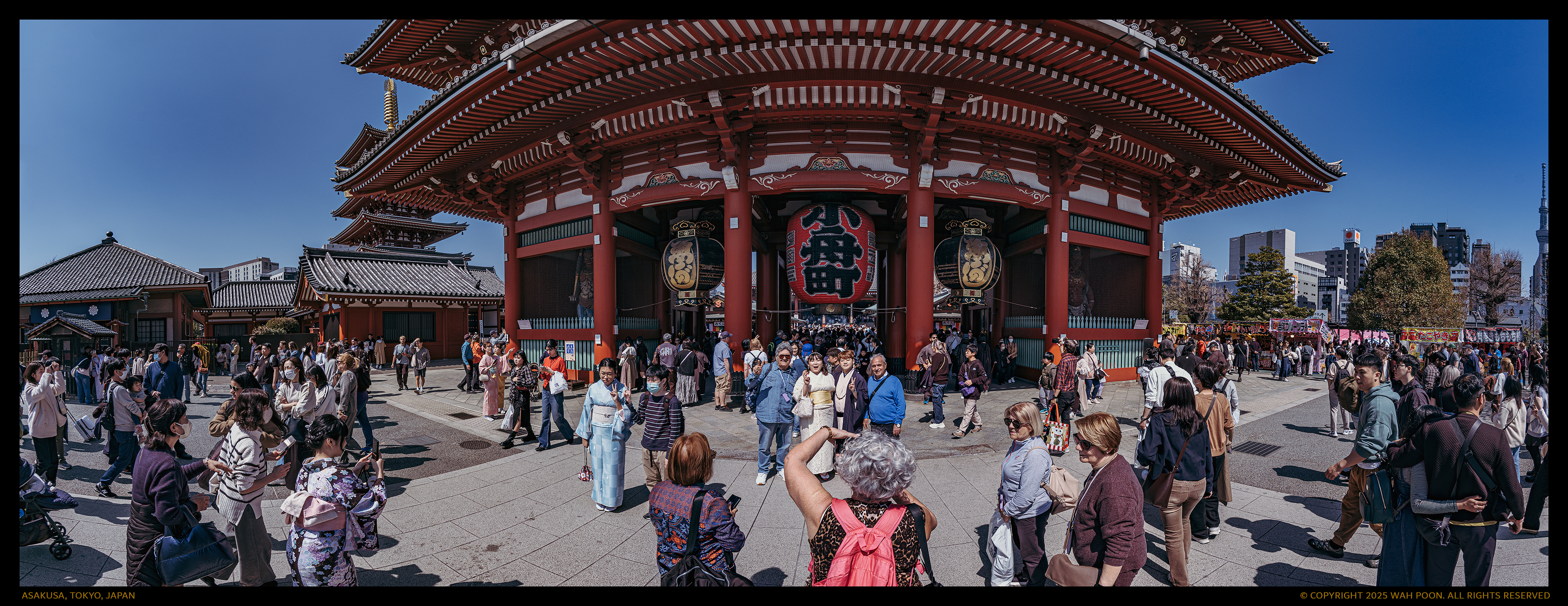
Asakusa represents the "Shitamachi" — the old downtown, historically home to merchants and artisans. Senso-ji Temple is the anchor, but the expanse view captures the vibrant, commercial energy of the Nakamise-dori approach. It is a reminder that Tokyo’s spirituality has always been intertwined with commerce. The wide frame shows the five-story pagoda not as an isolated relic, but as a participant in the busy street life that surrounds it, with the Tokyo Skytree visible in the background as a symbol of the city's ongoing vertical ambition.
Ueno and the "Edo" Landscape
Ueno Park was once the grounds of a powerful Buddhist temple, Kanei-ji, which was destroyed during the Boshin War of 1868. Today, it is a cultural grid of museums and a zoo, but the expanse panoramas reveal the remnants of its "Edo-period" landscape design. The wide view captures Shinobazu Pond and the way the park’s open spaces provide a visual "breath" in a city otherwise defined by compression. It is a space where the city’s historical identity as Edo — the shogun's capital — is still visible in the layout of the paths and the placement of the stone lanterns.
Technical Note
Tokyo panoramas were captured in March 2025 during cherry blossom season. The high dynamic range between shaded temple interiors and sunlit streets required careful exposure blending. Night shots at Shibuya used 3-frame HDR brackets.