Chongqing: The Mountain City
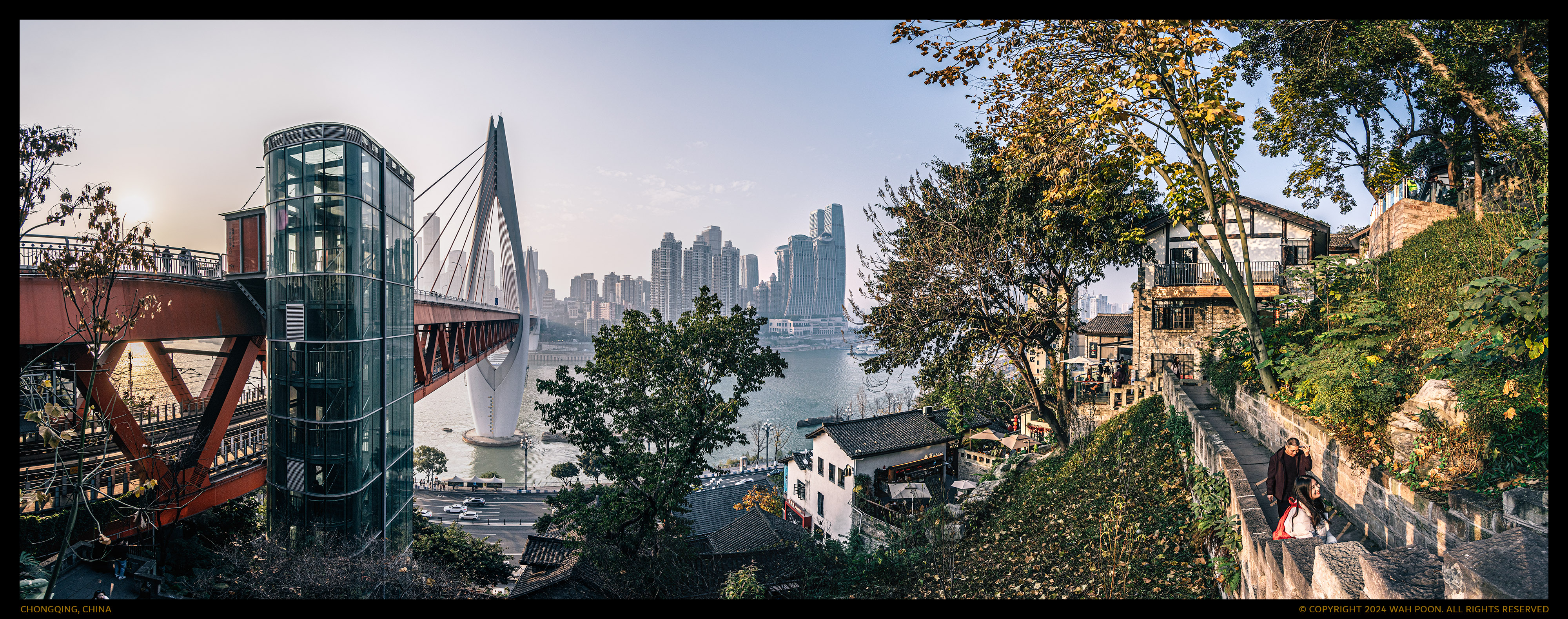
Chongqing is a city that refuses to be mapped in two dimensions. Known as the "Mountain City" or "Fog Capital," it is built on a series of steep ridges where the Yangtze and Jialing rivers collide. The urban fabric here doesn't spread out; it climbs. The result is a "3D urbanism" where the ground floor of a building can be a bustling street, while its roof serves as a landing pad for a monorail. A standard lens captures a single, impressive slice of this verticality, but the expanse view captures the disorienting reality of the place: a city where you can walk for twenty minutes and still be on the same "level" you started on.
We shot in December, embracing the city's famous atmospheric haze. The fog, which hangs over the rivers for much of the year, acts as a natural diffuser, softening the harsh glare of the neon and the concrete. In the wide frame, the city looks less like a grid and more like a geological formation — a series of concrete strata rising out of the mist. It is a place where the "infrastructure" — the bridges, the elevated highways, the cable cars — becomes the primary architecture.
Jiefangbei and the "Concrete Forest"
Jiefangbei is the city's commercial heart, perched on a narrow peninsula. In the expanse panorama, the district is defined by its "vertical compression." The Liberation Monument, once the tallest structure in the area, is now a small stone token surrounded by a canyon of glass. The wide angle captures the sheer density of the "concrete forest" — towers so close together they block out the sky, connected by a complex web of elevated walkways and subterranean tunnels that allow the city to function despite its lack of flat ground.

Hongya Cave and the "Stilted" Tradition
Hongya Cave is a modern interpretation of the *Diaojiaolou* — the traditional wooden stilt houses of the region's ethnic minorities. Built into the cliffside of the Jialing River, the 11-story complex is a study in structural adaptation. From the expanse perspective at night, it glows like a golden lantern against the dark water. The wide frame reveals its true context: a traditional form preserved not as a museum piece, but as a living, breathing commercial center in the shadow of the modern supertalls.
The Bridge Capital
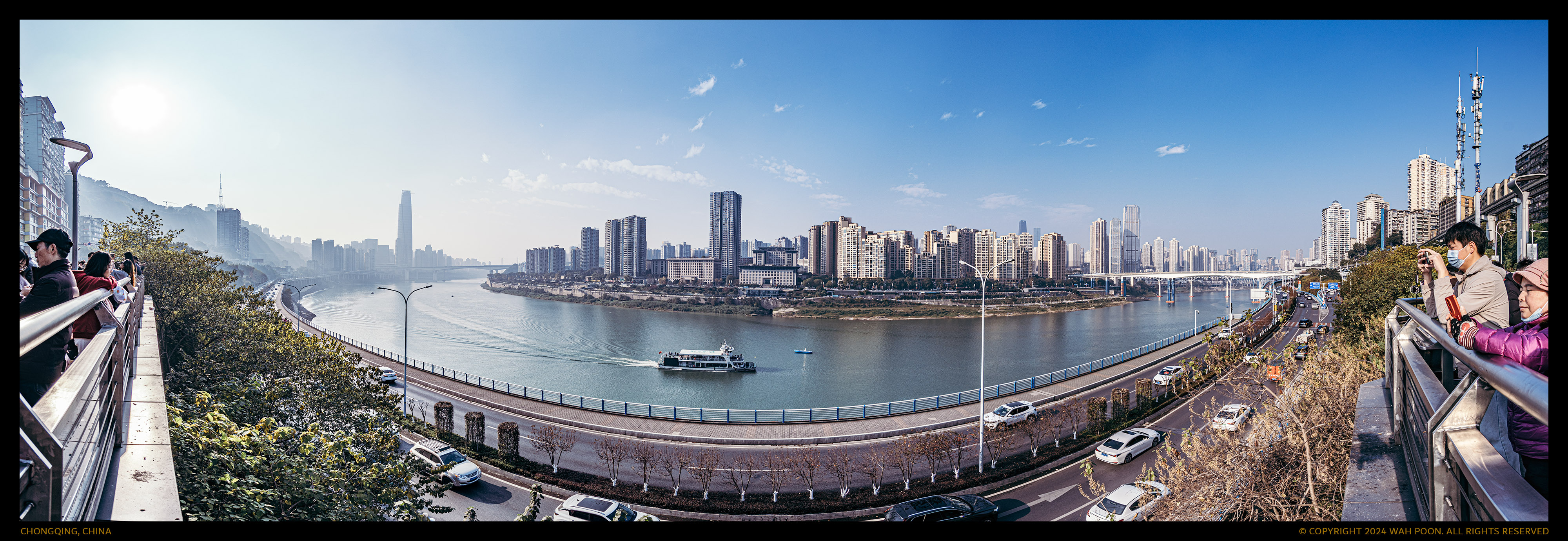
Chongqing is often called the "Bridge Capital of China." With dozens of major bridges spanning its two rivers, the city is a laboratory for civil engineering. The expanse view is the only way to capture the scale of this network. It shows how the bridges don't just cross the water; they knit the mountains together. You see the cable-stayed spans, the arch bridges, and the double-decked giants all in a single frame, working together to keep a city of 30 million people moving across some of the most difficult terrain on earth.
Technical Note
Chongqing panoramas were captured in December 2024. The city's notorious fog and high humidity required early-morning shooting for maximum clarity. Hongya Cave night shots used 5-frame HDR brackets to capture the full dynamic range of illuminated architecture against the dark river.